
Reading a lookup result
What every phone flag, trust grade and address result means, and where to find them.
6 min read
Tip
A red Result badge means the number was found on at least one list. Open the row to see the full record.
The history on Lookups lists your lookups. Which ones it shows depends on whether you are working in a CRM account, as Finding and exporting past lookups explains. The Result column gives the short answer. Open a row to see everything that came back.
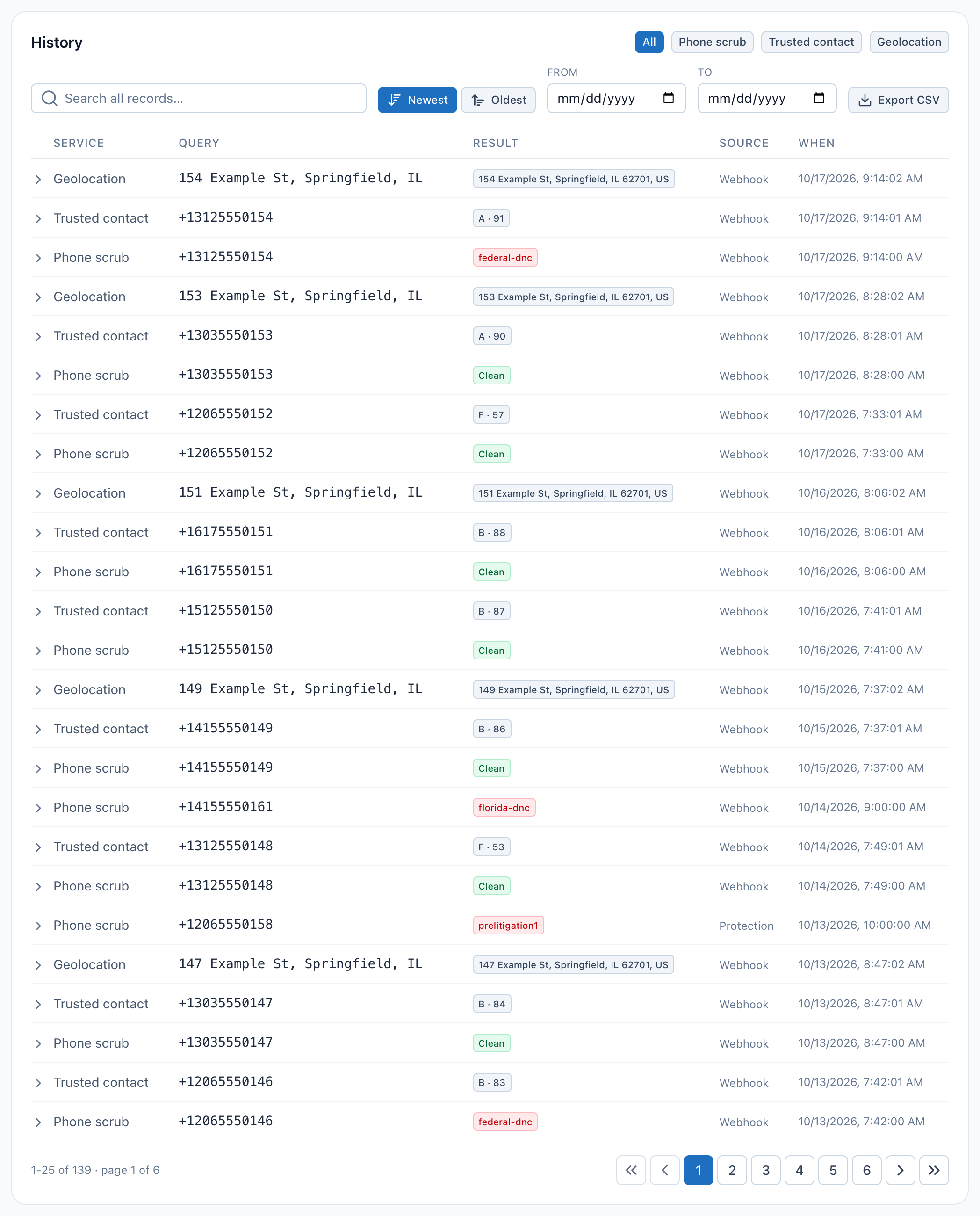
- The Result column holds the short answer for each lookup.
- A red badge on a phone scrub lists every list the number was found on.
- A trust grade and score, here F and 57, for a contact verification.
- The standard address for a geolocation lookup.
- The arrow at the start of a row opens the full record.
Phone scrub results
A phone scrub checks the number against Do Not Call lists and litigation lists. The badge reads Clean in green when nothing matched. When something matched, it turns red and lists each match by its code.
| Code | What it means |
|---|---|
federal-dnc |
The number is on the National Do Not Call Registry. |
colorado-dnc, florida-dnc, indiana-dnc, pennsylvania-dnc, texas-dnc, wyoming-dnc |
The number is on that state's own Do Not Call list. |
plaintiff-primary |
The number is known to have received the call or text that started a TCPA lawsuit. |
plaintiff-secondary |
The number is likely tied to a TCPA plaintiff or their household, but not certainly. |
attorney-primary |
The number is known to belong to an attorney representing a TCPA plaintiff. |
attorney-secondary |
The number belongs to another attorney at a firm that files TCPA suits. |
prelitigation1 |
The owner has filed a TCPA lawsuit or sent a written demand letter threatening one. |
prelitigation2 |
The owner has verbally threatened a caller with a lawsuit. |
anti-telemarketing |
The owner is a member of an anti telemarketing group. |
gov |
The number belongs to a state or federal government office. |
reassigned-number |
Premium only. The FCC Reassigned Numbers Database says the number was permanently disconnected since your consent date, so it may belong to someone new. |
The full record also shows two more fields.
- Wireless is
1for a mobile number and0otherwise. Many calling rules treat mobile numbers differently, so this is worth knowing even on a clean result. - Message names the kind of list matched, in words.
On a premium lookup the full record also carries Rnd, which holds the database answer (yes, no or no_data) and the date it checked from. A note of default-consent-window means the check ran on its own, in an automatic screen or 30 day Protection, so it covered the last 30 days and is not consent dated. A lookup, re-scrub or API request you start always uses the date you gave.
Important
DialClear reports what each list says about a number. Whether you may call it is your decision, and this article is not legal advice.
Trusted contact results
A trusted contact lookup asks one question. Does this name really belong to this phone number? The answer is a score from 0 to 100 and a letter grade, shown together in the badge, for example A+ · 100 or F · 59.
The grade
| Score | Grade |
|---|---|
| 97 to 100 | A+ |
| 93 to 96 | A |
| 90 to 92 | A- |
| 87 to 89 | B+ |
| 83 to 86 | B |
| 80 to 82 | B- |
| 77 to 79 | C+ |
| 73 to 76 | C |
| 70 to 72 | C- |
| 67 to 69 | D+ |
| 63 to 66 | D |
| 60 to 62 | D- |
| Below 60 | F |
A and B grades are a good match. C and D are worth a second look. F means the name and the number do not line up well.
The full record also has a Band. It is high from 75 up, medium from 45 to 74, and low below 45. The band is the same score in three coarse steps, and it is what lands in your CRM as Trust Band.
What moves the score
The score blends whichever of these signals came back for the number.
- The closer the name you gave is to the caller ID name on the line, the higher the score. This is the biggest standard signal.
- The premium carrier identity match compares the name against the carrier's own customer records. When it runs, it carries the most weight.
- A mobile line scores best and a landline nearly as well. Internet phone numbers that are not tied to an address score low.
- An inactive, disconnected line pulls the score down, because the caller ID on it usually describes the previous owner. A phone that is just switched off does not lower it.
The Reasons field in the full record lists what drove the score in short codes, such as name-matches-caller-id, name-does-not-match-caller-id, mobile-line or line-inactive.
Geolocation results
A geolocation lookup turns an address or ZIP code into a standard address. The badge shows the address as the post office would write it.
The full record includes the street, city, county, state, ZIP and country in short and long forms, the latitude and longitude, and the time zone. Timezone is the one most people use, because it tells you what time it is where the contact lives before you call.
A ZIP code or a state on its own gives a rougher answer that centers on the area rather than a street.
Where else results show up
- Right under the lookup card on Lookups, just after you run a manual lookup.
- In the results file of a bulk scrub. See Scrubbing a list of numbers in bulk.
- On the contact in your CRM, in the
DialClear | ...custom fields, when the lookup ran on a CRM contact. See See a contact's verification result in your CRM.
Frequently asked questions
Why is a number flagged when the person agreed to hear from me?
A list match and consent are separate questions. DialClear reports the match. Whether you may call is your decision.
Why does every lookup for the same number show the same grade?
The grade depends on the name and number you gave and on the line itself. Until one of those changes, the answer stays the same.
What does a dash in the Result column mean?
The lookup returned no single value to summarize. Open the row to see the full record.